Nam June Paik, Me, Patternflow
On being together.
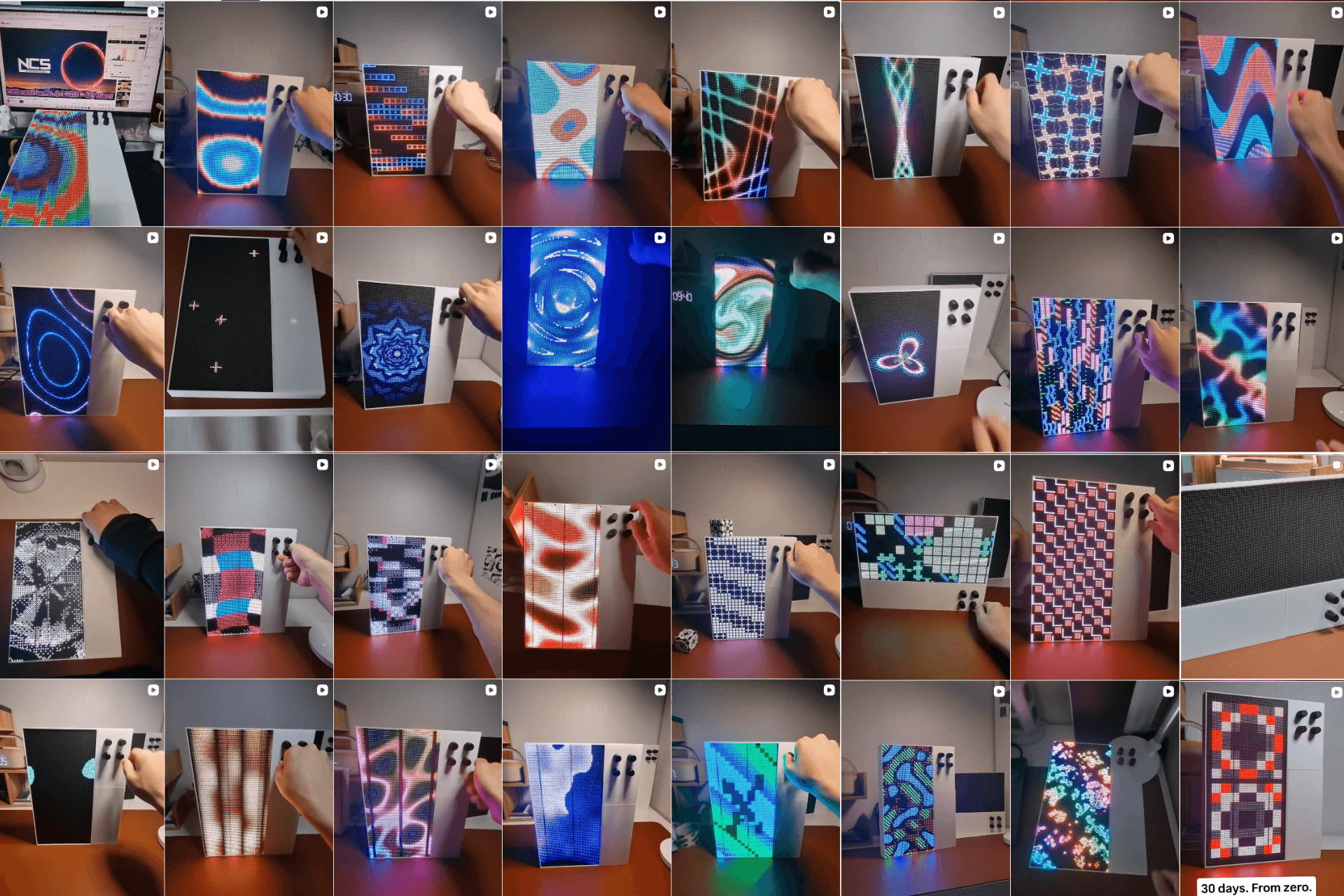
This piece centers on Patternflow, my own work, a contemporary reinterpretation of Nam June Paik's early participatory piece Participation TV. Starting from a 20th-anniversary memorial event for Paik that I stumbled into, it traces how Patternflow was born and how it connected me to people around the world. At the same time, it's a record carrying a hope: that maybe I can find, in Paik, the direction and the attitude toward life I'm reaching for. Patternflow is an open-source LED synthesizer, and an ecosystem, for bringing interactive media art to everyone.
1. Opening
This is also the final report for the Modern and Contemporary Korean Artists course I'm taking this first semester of 2026. Except it isn't a usual artist study. It's closer to an essay, and a way of organizing the next step for Patternflow, which from January to June this year was my entire life.
This past January, I went to the Nam June Paik Art Center for the first time. My real purpose was to see another artist's exhibition there. Once I'd done that, I experienced Paik's permanently installed works in person too, and by chance caught a 20th-anniversary memorial event. Around the same time, I was turning over my first work, with the ambition of debuting as a media artist and holding a solo show within a year. I ran several experiments, and one of them got an unusually good response. It felt like an opening, so I developed it, and that became today's Patternflow. By now, as open source, it's no longer only mine, and as its first creator I feel responsible for laying down its foundation and the direction ahead.
I wanted to fill this first semester of my third year in Visual Communication Design at Hongik University entirely around artists, too. I took the relevant courses and, naturally, ended up analyzing Nam June Paik. What I fixed on was communication. And two currents of communication run through this piece and through Patternflow. The first is communication with strangers around the world; the second is communication with myself. I ran the analysis of Paik and the analysis of myself side by side. In the end, raising Patternflow well became an attempt to grow myself in a good direction, and this piece is me trying to find the place where those two currents lock together.
2. Thoughts on Nam June Paik
Nam June Paik is famous for works that use the TV. There's TV Buddha, which made him an artist people recognized; there's The More the Better, overwhelming in scale; and there are the later, communication-forward works, Good Morning, Mr. Orwell and Global Groove. The later works, though, didn't much interest me. They were made after he was already famous, and the sheer awe of their scale came first. The early works pulled me in. They felt like only the essence was left. In a time when he had nothing, I think he did, more purely, only the things he wanted to.
His consistent subject was communication. He wanted the audience to become the owner of the work; he broke and hacked one-way technology and rewired it into something two-way. Why communication, of all things? Let me guess. Paik spoke several languages, but, they say, none of them perfectly fluently. The English and the Korean I heard from him in documentaries both sound somehow foreign. Someone said he spoke "Paik's language." That's how peculiar it was, and that's how hard it was to understand. He must have had few experiences of connecting with others through the language of words and speech. Out of that lack came a hunger for communication, and in his work it took the form of audience participation. So for him, participation was, before it was an aesthetic, his own way of talking, a detour to communication.
At the same time, he loved chance. The "this very moment" of the Zen Buddhism he was absorbed in doesn't arrive on schedule; it just arrives. Mainstream art, where everything is controlled and rehearsed and climbs onto a finished stage, must have felt stifling to him. So he handed the roles and reactions of audience and machine over to chance. The belief that life is not in the perfectly controlled thing but in the unpredictable one. It looks less like a stance toward his work than a consistent attitude toward everything he met in life. With others and with himself, too, he could refrain from trying to control, and simply accept. This disposition made him intensely human. That's why you can feel human warmth even in the works he built out of technology.
The more time passes, the more I envy Paik's attitude toward life. He said that from the moment he gave up on how others saw him, he became incredibly free. At his funeral, Yoko Ono said in her eulogy that Paik was the Buddha in her heart she leaned on whenever things got hard. In the media his presence is innocent, childlike, cantankerous and yet clearly surrounded by friends. Because he lived as himself.
There are parts that puzzle me, too. How someone born the youngest child of one of Korea's wealthiest families, who studied abroad on that privilege, could live poor, could choose such a life, I don't get. That he made a work smashing the Buddha statues that had made him a recognized artist is strange too. And that, having planned it himself, he handed the actual moment of severing the head to someone else and slipped away: that's fascinating. A man who gathered Buddhas and succeeded because of them cuts off a Buddha's head, and at that very moment runs away himself. The contradiction only heightens Paik's humanity.
I'm curious what kind of person Paik really was, how the people around him saw him. He himself was indifferent to it. To me now, over-conscious of others' eyes, that indifference is the attitude toward life I envy most, and most want to learn.
3. The Person I Am
I feel I have to smash the things I've believed until now. Like Paik's "kill the Buddha, kill the patriarch," or like the opening of Carl Jung's Red Book. It's the work of killing my own hero. The reason is that I want to become the person I really want to be. Someone others call first to come play. Someone it's just good to be with, for no reason at all.
In the roughly two years of therapy I've kept up, I feel like I've caught a thread of something. I shouldn't live so extremely, so binarily. Until now I've grabbed only at the things that shine, and thrown the rest away without even a chance to reconsider the verdict. It's the same with people. I can't bear the uncertainty of a relationship, so I take it as one of two things, like or dislike, and then I try to make it that way. If it's ambiguous, I'd rather push it toward dislike. These experiences repeated until I ended up with a belief that "being good at the work" and "being a good person" can't coexist. And I keep trying to throw the latter away without mercy.
My attitude toward my work and toward myself is strange, too. I can take my work being criticized, attacked. Even if it's a professor, if they think differently from me I dismiss it, what would you know. Their failing to understand the intent isn't my fault, so it lands no blow. But I can't take a person disliking me. I've armored the work all over with intent and dismissal, and left myself standing there bare. I collapse at even an offhand remark with no intent behind it. I stand my works up proudly, and have no confidence in myself.
My therapist said this: living without minding human relationships, looking only at results, isn't wrong either. If I myself am okay with it, that's a perfectly good life too. But from all our talking and her watching, she said, that isn't the life I want. I know. I just want a life with many people to be with. One day, walking home after a meal with some older friends, I cried. Because I'd heard: "It's amazing you can live so hard even on your own, I envy that. Me, I just meet friends and hang out." Walking along the Han River, I chewed the sentence over and over. I want to play often too, just like you. I only live hard because no one calls for me, because then, maybe, someone will. You call me amazing, say you envy me, but really, I envy you, a great deal.
Paik became free the moment he gave up others' eyes, and I'm standing on exactly the opposite side. I always have to look impressive and capable, and through that be acknowledged. If I can't, I can hardly bear the me that's nothing. So even if I can't learn his freedom, I want to understand a little of it. Maybe it wasn't that he resolved to stop caring, but that he lived absorbed in something he could focus on more. That's what I've been thinking lately. And "Patternflow," for me, feels like that "something."
4. Patternflow
Patternflow is an open-source LED synthesizer you play with your fingertips. Turn the knobs and the flow of the creative-coding pattern on the LED matrix shifts. Light stops being a visual effect you only look at and becomes a multisensory experience tied to the touch of your fingers. And as an ecosystem rather than a single device, its core is "make it easy to build." It's a contemporary reinterpretation of Paik's Participation TV. Where Participation TV brought the audience's participation into art, Patternflow tries to put creation itself into everyone's hands. Beyond operating the work, the audience becomes a creator who makes, fixes, and shares. So it didn't stop at being a single object; it became an ecosystem aimed at bringing interactive media art to everyone.
I've published every material and guide you need to build it openly on GitHub, so anyone can make one. And even without a device on hand, you can use the website's AI pattern-generation system and simulation to make and play your own pattern. Making creation easy. That's all Patternflow is.
5. How It Started
At first it looked very different from now. Originally it was a 3D-printing-based art-tech project, and it didn't go as well as I'd hoped. In the middle of that, my younger sibling said it'd be nice to put it on an LED matrix, and that became the turning point. It had been a lukewarm experiment, but the retro glow of the LED matrix, and the charm of changing it by turning the potentiometer wired to it, captivated me. After many more experiments, it took shape as a portable, minimal art object. The content I posted to Instagram and the post I put on the Arduino subreddit drew good responses one after another, and the comments saying they wanted to build it stood out more than the ones saying they wanted to buy it. The fact that Patternflow could be a spark for someone's curiosity and urge to create made me proud, and I decided to switch to open source.
There was another reason for going open source: I felt I couldn't do it alone. Doing this, I soldered for the first time in my life. After class, every day, I sat in the club room fixing solder until eleven at night. That's how I made my first PCB, too. Knowing nothing, I gave up my weekends and my sleep and barely pulled it off. I could see things to improve across so many areas, and doing it alone, I thought, was the kind of thing that eats away at your lifespan. I went open source because I want to live long and healthy. And people came to help. From the countless comments of support, to PCBway, who directly funded the cost of experiments, to a collaborator who makes and shares their own patterns and is building one of the pattern-generation features, to the people who shared what they'd built and tested on Discord.
And I'm recording this whole process and making it public. Back when I wanted to become an artist, the thing that frustrated me most was the absence of process. There's plenty of achievement and result, but the story of the effort and struggle to get there was hard to find. Because you can't know how hard, and how fun, that process is, I couldn't make the choice of "artist" easily. So through Patternflow I decided I'd do it myself. Sometimes it's so transparent it gets closer to a diary than to intent, but hoping someone reads this and finds the courage to make something of their own, I keep writing.
6. Where Things Stand Now
As of today, June 7th, Patternflow is trying to step onto the edge of business. Even art needs money to be possible. So beyond maker and artist, I'm trying to take on the attitude of an entrepreneur, a maintainer. I want to raise the ecosystem well, so that even after I leave to do other work someday, it survives on its own. To show what the device can do, I experimented with all kinds of patterns and audio-reactive features, and now it feels like enough. I have to lay the ground so that new and varied lives can live in the ecosystem.
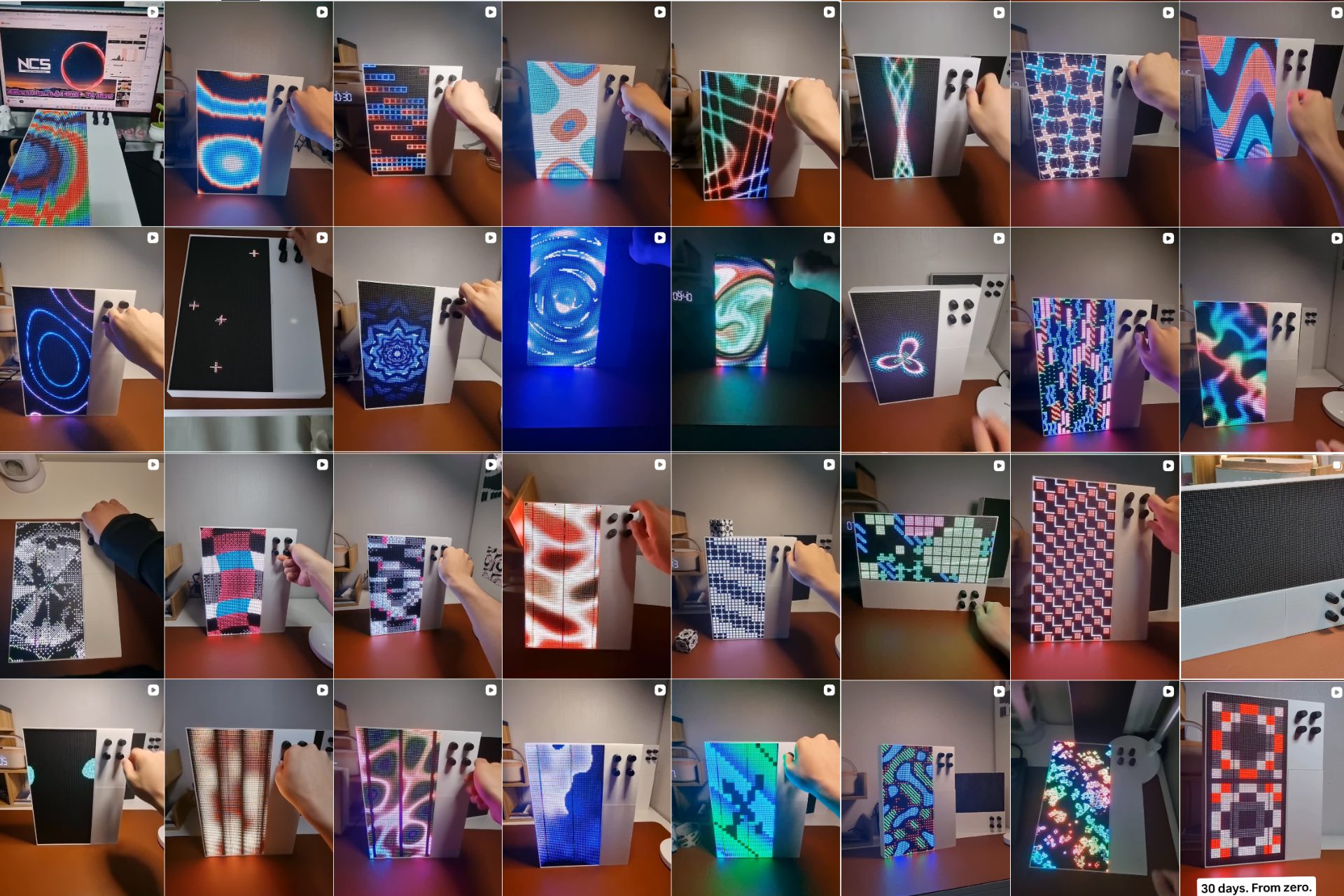
Let me write a little more specifically about patterns. The first entry point will stay, as before, the AI-based pattern-generation feature. In keeping with the motto "make it easy to build," it's there to help even beginners who can't write code have the experience of creating their own pattern. Doing it and showing it is the most intuitive. So every day, for an hour or two, I talked with the AI, made all kinds of patterns, and posted them to Instagram as reels. About thirty piled up that way. The time spent making them was hard, but it was actually easy work. I just had to repeat it, like a ritual, every day. A few days ago, the Patternflows I had broke. It felt like a sign: this is enough, stop, move on to the next step.
The feature for putting your own image or text on top of the AI-generated pattern is being built by the collaborator. I want to trust them with that part and focus on collaboration. I want to work with the music producers who've shown interest in Patternflow, and with pixel artists and creative-coding artists. They'll likely become the heavy users, and that's how the ecosystem can sustain itself, I think. How to approach it, I don't know yet. First I have to focus on the global crowdfunding with Crowd Supply (which I signed on my birthday, May 29th) and all kinds of business work. So I'm pretty scared. Everything feels new, unpredictable, beyond control. Still, it's fun.
7. Being Together
By nature I'm a very independent person. More than that, a dictatorial one. I hold the yardstick I judge myself by up to others and try to control them. Every team project came to one of two endings. First, gripping control and building it exactly as I think. The results are good, but no people remain. The bigger problem is when I can't get control. I can't bear the uncertainty, so I leave. And in the process I cause problems. Naturally, no people remain. By now I'm afraid to build stake-relationships with people who were personal ones, because I've learned that at the end of it there will be no one left.
I want people to remain. So Patternflow's direction is for others and for me at once. The hardest thing: an attempt to take people and community into my arms and try to bear the uncertainty. I want to hand the remaining half of Patternflow to others and go together. It'll keep being anxious and hard, and for that reason I'll want to throw it away, but I hope that, even just because of how much I've already put in, I can keep going. Looking back, even getting this far was only possible thanks to many people's help. The sibling who suggested the idea, the people of Reddit whose unstinting encouragement got me through the hard soldering and circuit work, the person who offered sponsorship first, the people who answered kindly when I posted asking for help with a hardware problem, and the many others who've been in it with me.
More than anything, the happiest moment is when someone shares what they made and asks me about it. Not one-way acknowledgment, but being able to feel that we're in it together. I now know that's what I really want. This is where I meet Nam June Paik. Just as he made participation out of a lack of communication, I make my own participation. I want to sit people down at the workbench, and pull up a seat beside them as one participant among them. If Patternflow truly becomes a living ecosystem, it won't stop at being a simple open-source success story. It'll be proof that I took a step forward in the very relationships I struggled with most, and a safe home I can always return to. A place where the macro and the micro, the global and the solitary kinds of communication meet. Maybe they aren't different things at all.
8. In Closing
So Patternflow is one person's desperate flailing. Even if it doesn't shine right away, I mean to wait. I want to become free of others' eyes and to see myself properly. I want to become someone people call first. To live as myself, alongside other selves. If I manage that in Patternflow, if that's one step forward, I won't settle. I'll go further. There are several projects I want to try. I always want to be making something new. That's when I feel alive.